In the field of contemporary criminalistics, investigators frequently encounter cases where traditional physical evidence—such as latent fingerprints or high-quality DNA profiles—is absent or severely degraded. When physical crime scenes are scrubbed or bodies are moved across geographical borders to mislead law enforcement, forensic scientists look toward a hidden microscopic tracker: pollen and spores. This specialized field, known as forensic botany or palynology, applies the study of living and fossilized plant micro-particles to civil and criminal legal proceedings. Because these microscopic dust particles feature highly unique structures that vary by region and season, a rigorous forensic palynology analysis can link a suspect directly to a specific square meter of soil. By utilizing advanced light microscopy and scanning electron diagnostics, laboratory technicians are turning raw environmental dust into an unyielding witness for the prosecution.
What makes this microscopic evidence an exceptional focus for case investigations is the physical durability of the pollen grain itself. By stripping away surface-level guesswork and focusing on the chemistry of the exine outer shell, the tracking of localized plant profiles, and the mechanics of clothing fibers, modern labs utilize forensic palynology analysis to break down deep geographic timelines.
1. The Indestructible Chemistry of the Exine Outer Shell
The primary reason pollen serves as an incredible tracker in modern crime scene reconstruction is its structural resilience against natural decay. While human biological tissue decomposes rapidly when exposed to the elements, plant micro-particles can remain fully intact for thousands, or even millions, of years.
This extreme survival capacity is due to a highly specialized organic polymer that forms the outer wall of a pollen grain, known as the exine.
The exine layer is composed primarily of sporopollenin, one of the most chemically resistant organic molecules found in nature. Sporopollenin easily resists high temperatures, strong enzymatic breakdowns, and intense exposure to industrial acids. When an investigator performs a forensic palynology analysis on muddy boots, car tires, or clothing fibers, the laboratory uses harsh chemical washes—including concentrated acetic acid—to destroy all non-pollen organic material. Because the sporopollenin shell remains untouched by these acids, technicians can isolate pristine, clean pollen specimens from older or heavily degraded evidence samples.
2. Microscopic Morphological Tracking and Plant Taxonomy
To the naked eye, the yellow dust falling from trees looks completely uniform. However, under high-magnification scanning electron microscopes, every single plant family reveals a distinctly unique geometric structure.
During a standard forensic palynology analysis, a palynologist identifies and categorizes these micro-particles based on specific physical characteristics, including their size, shape, surface textures, and the layout of their aperture openings.
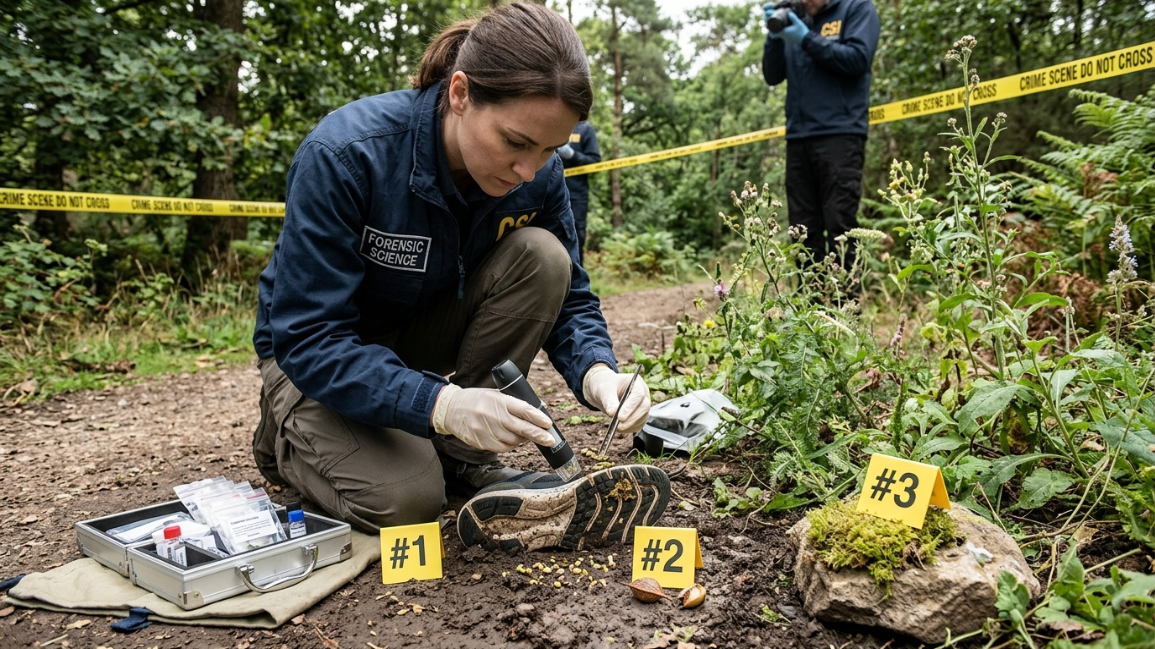
Gathering trace residues from evidence surfaces.
For instance, pine trees produce large, distinctive pollen grains featuring two hollow air bladders that look like cartoon ears. Grasses produce small, smooth spheres with a single circular pore, while daisy families display sharp, spike-covered walls. By mapping these detailed physical markers, the laboratory can pinpoint the exact genus and species of the plant that produced the pollen, establishing a clear link to local plant growth.
📊 Botanical Micro-Particle Forensic Matrix
| Diagnostic Marker | Microscopic Trait Discovered | Core Forensic Value | Impact on the Target Investigation |
| Sporopollenin Exine | Highly rigid, acid-resistant outer structural wall | Survives intense decay and chemical washing | Allows extraction from degraded materials |
| Aperture Patterns | Specific lines, slits, or pores on the shell surface | Determines the exact plant family and genus | Identifies the vegetation zone of a crime |
| Pollen Assemblage | A unique percentage mix of multiple regional species | Generates a distinct geographic fingerprint | Exposes false alibis and tracks travel history |
3. The Power of the Pollen Assemblage Profile
A common misconception is that a forensic palynology analysis relies on finding a single, rare plant grain to crack a case. In everyday practice, the science relies on a statistical concept known as the pollen assemblage profile.
Every geographic zone features a highly specific mix of vegetation, shaped by local soil types, water access, and regional climate conditions.
As plants release their micro-particles into the air, they settle into the dirt to create a highly localized “pollen fingerprint” unique to that specific area. A sample taken from an old forest might show a mix of 60% oak, 20% fern spores, and 5% river willow, while a sample from an open field just two miles away might contain 80% wild grasses and 10% agricultural crops. When a suspect’s vehicle or clothing undergoes a complete forensic palynology analysis, technicians count hundreds of grains to map out the exact percentage mix. If the profile recovered from the suspect’s belongings matches the specific mix of the crime scene, it provides powerful evidence that completely dismantles false alibis.
4. Locard’s Exchange Principle and Clumped Fiber Taphonomy
The backbone of modern crime scene investigation relies on Locard’s Exchange Principle, which states that “every contact leaves a trace.” This law is incredibly apparent when examining how pollen transfers onto woven fabrics and clothing fibers.
Because pollen grains are microscopic, lightweight, and frequently covered in sticky oils or tiny attachment hooks, they become tightly trapped within the weaves of wool, cotton, and synthetic clothing.
During a thorough forensic palynology analysis, laboratory techs pay close attention to whether the discovered pollen is lightly dusted across the fabric or found in thick, compressed clumps. Lightly dusted pollen can easily travel through the air over miles, meaning it only proves a general regional presence. However, if the analysis recovers thick, concentrated clumps of pollen, it proves the suspect made direct, intimate physical contact with a blooming plant at the scene. This physical tracking can place a suspect directly at a specific bushes or hidden trail where a crime occurred, providing a solid link that is virtually impossible to clean away or hide.
5. Overturning Time and Space Challenges in Cold Cases
The final and most impressive capability of a complete forensic palynology analysis is its power to crack decades-old cold cases and track the movement of bodies over long distances. Because soil profiles vary drastically around the world, pollen analysis can instantly expose if a body was moved after death.
If a victim is discovered in a pine forest, but a chemical audit of their clothing pulls a profile dominated by rare coastal palms or specific marsh reeds, investigators know immediately that the murder took place elsewhere.
Furthermore, because ancient fossilized spores or extinct plant pollen lines remain trapped inside deep rock layers, they can link modern dirt to specific industrial quarries. If a suspect’s shovel contains recent soil mixed with unique fossilized pollen from an old geological layer, a forensic palynology analysis can match that specific mix to a single open trench or burial site. This capability turns simple dirt into an unalterable map, allowing modern investigators to piece together timelines from cold cases that have been cold for decades.
The Analytical Verdict on Forensic Botany
The study of microscopic plant evidence stands as an incredibly powerful, objective tool within modern criminal justice. As this technical breakdown of forensic palynology analysis proves, the microscopic dust produced by nature functions as an unalterable tracking device.
By taking advantage of the chemical durability of sporopollenin, the detailed structures of different plant families, and the unique percentage profiles of local vegetation zones, forensic science can reconstruct complex crime scenes with total clarity. Operating silently in the background of nature, these micro-particles build an undeniable scientific bridge between a suspect, a victim, and a location. The deep science carved into these microscopic shells remains an essential pillar of modern forensic tracking, proving that the smallest traces can solve the most complex human mysteries.